5 Tools for Building and Deploying AI Agents in Production
A practical walk-through of LangGraph, E2B, Mem0, LangSmith, and Modal, the five tools that make up a real production AI agent stack, with the honest tradeoffs for each one.
Building an agent that works in a notebook takes an afternoon. Getting that same agent to survive real traffic, recover from a crash at 3 a.m., and not leak someone else's data while it runs LLM-generated code is a different job. Most teams underestimate exactly how different.
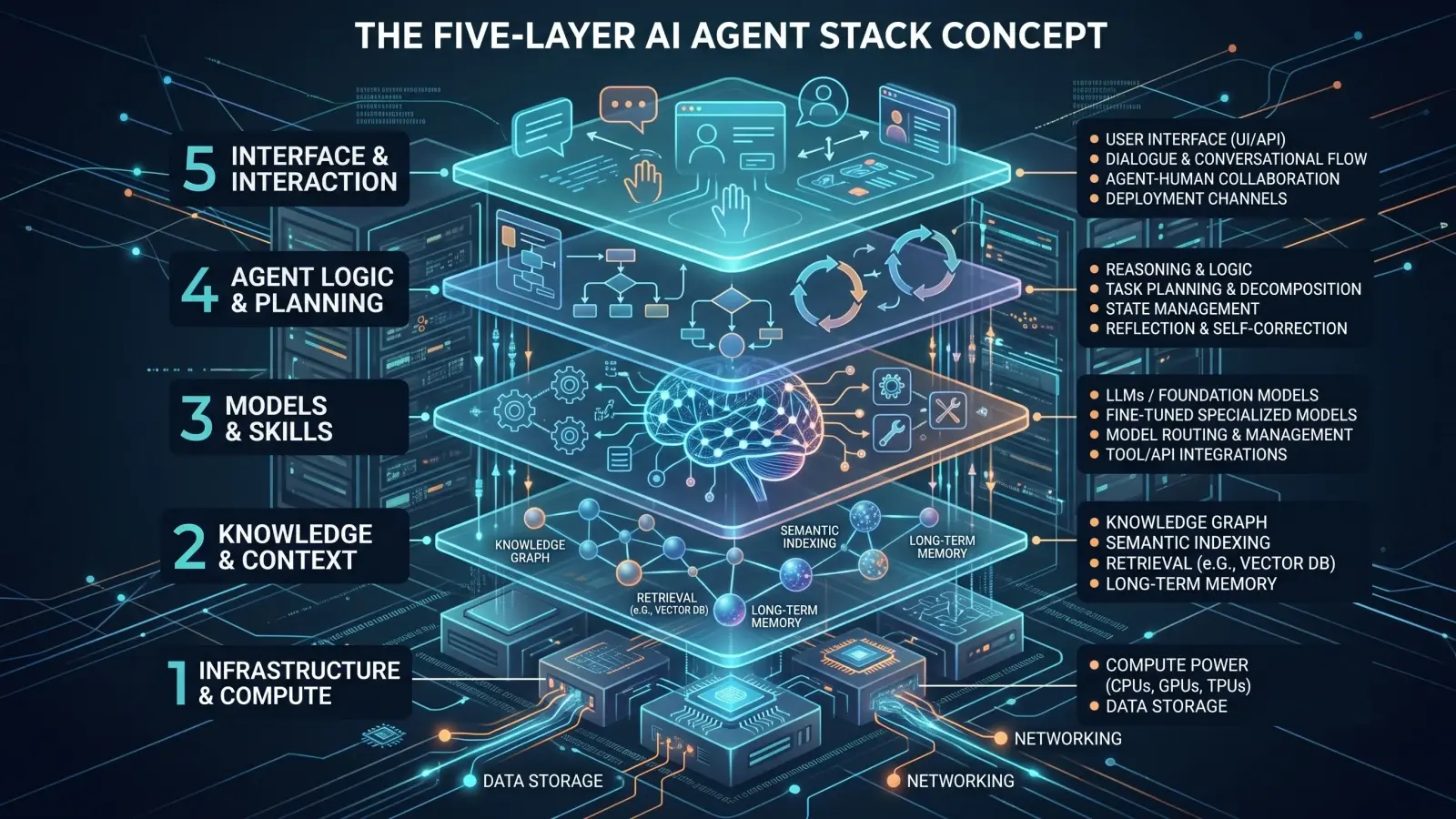
The gap usually isn't the model. It's the five layers underneath it that nobody thinks about until something breaks: how the agent's logic is structured, where it safely runs the code it writes, whether it remembers anything past a single session, whether you can see what it actually did, and what it's all running on when traffic spikes at 2 p.m. on a Tuesday.
This piece walks through one tool for each of those five layers. None of them compete with each other. Most production agents you'll run into in 2026 use some combination of all five, and understanding why is more useful than picking a "winner."
What Does a Production AI Agent Stack Actually Need?
A demo agent is a script. A production agent is a system with state, isolation, memory, visibility, and somewhere to run. Skip any one of these and something specific breaks: skip persistence and a crash erases hours of work, skip sandboxing and generated code runs somewhere it shouldn't, skip memory and every session starts from zero, skip observability and failures happen in the dark, skip elastic compute and you're either overpaying for idle servers or scrambling when load hits.
Here's one tool for each layer, with the honest tradeoff for each one.
What Is LangGraph and Why Does It Matter for Agent Orchestration?
LangGraph represents an agent as a directed graph instead of a flat while-loop calling an LLM. Nodes are functions, edges connect them with optional conditional routing, and every execution is tracked as a series of checkpointed state transitions rather than a flat message list.
That checkpointing is the whole point. According to LangChain's own State of Agent Engineering report (LangChain, 2026), over 60% of production agent incidents trace back to state management failures. That's the single leading cause of agent breakage in production, ahead of bad prompts, tool errors, or model mistakes. LangGraph exists specifically to close that gap.
Klarna, LinkedIn, Uber, and Replit all run agent workflows on LangGraph, and its GitHub repository has passed 30,000 stars. The framework lets you pause a workflow for human approval, resume it after a crash, and even "time travel" back to an earlier checkpoint to debug what went wrong, all without you building that infrastructure from scratch.
Here's the catch worth knowing before you adopt it. The default in-memory checkpointer works fine for development, but it stores state in memory only, and it loses everything the moment the process restarts. That's unacceptable for anything real. Almost every team moves to a Postgres-backed checkpointer the moment they go to production, and that one-line swap is usually the actual moment a LangGraph project stops behaving like a script and starts behaving like infrastructure. LangGraph's core framework is free and MIT-licensed. The managed LangGraph Platform starts around $35 a month, with node-execution fees on top once you scale.
How Does E2B Handle Sandboxed Code Execution?
The moment an agent can write and run its own code, you have a problem your web server was never built to handle. You cannot run model-generated Python on the same machine serving your users, because you have no way to know what that code will try to do. You need an isolated, disposable environment you can destroy the second the task ends.
E2B is built specifically for that. It focuses on ephemeral code execution using Firecracker microVM isolation, meaning each sandbox gets its own kernel and its own virtual machine, not just a container sharing the host's kernel. That's a meaningfully stronger security boundary than container isolation alone, and it's fast: sandboxes restore from a snapshot in under 30 milliseconds.
"Enterprises have enormous expectations for AI agents. However, we're asking them to scale and perform on legacy infrastructure that wasn't designed for autonomous agents," said Vasek Mlejnsky, co-founder and CEO of E2B, in an interview with VentureBeat. E2B says it's used by 88% of Fortune 100 companies for agentic workflows, and named customers include Perplexity, Hugging Face, Manus, and Groq.
The tradeoff to know going in: E2B's runtime limits are tier-based, capping at one hour on the free Hobby plan and 24 hours on the $150-a-month Pro plan. That fits short, ephemeral tasks well, like running a script or testing generated code. It's the wrong tool if your agent needs to hold state open across days. If that's your situation, it's usually a sign you need the memory layer below, not a longer-running sandbox. E2B also doesn't offer GPU passthrough, so anything compute-heavy needs a different provider.
How Does Mem0 Give Agents Memory That Outlasts a Session?
Every LLM call starts from zero unless you hand it relevant history yourself. For a single question, that's fine. For an agent meant to remember a user's preferences across sessions, or pick up a multi-day task where it left off, a model with no memory quietly forgets everything that made it useful.
Mem0 extracts the facts worth keeping from a conversation and stores them in a vector database tagged by user, session, and agent. When the agent needs them again, Mem0 retrieves what's relevant using a blend of semantic similarity, keyword matching, and entity matching, and hands that back before the model responds. The agent appears to remember you. What's actually happening is a targeted retrieval step running quietly before every reply.
This pairs naturally with LangGraph, and it's worth being precise about why. LangGraph's checkpointers handle short-term, thread-scoped memory well: conversation continuity and fault tolerance within a single run. They aren't built for durable, cross-thread memory, like a user preference that needs to survive across two completely separate sessions three days apart. That's a different job, and it's the one Mem0 is built to do. Mem0 offers a free tier (10,000 memory-add calls and 1,000 retrievals a month), a Starter tier at $19 a month, and a Pro tier at $249 a month with graph-memory features for entity linking.
LangSmith: Seeing What the Agent Actually Did
An agent that fails silently is worse than one that fails loudly. At least the loud failure tells you where to look. Tracing, meaning a record of every tool call, decision, and observation an agent makes, is the unglamorous piece of any production agent that you cannot skip.
LangSmith is built for this and pairs closely with LangGraph, though it works with other frameworks too. It gives you a full run-by-run replay, not just the final output, so you can see exactly which step diverged from what you expected. That distinction, between knowing an agent failed and knowing why, is usually the difference between a five-minute fix and a multi-day investigation.
The free Developer tier includes 5,000 traces a month with 14-day retention and no credit card required. The Plus tier runs $39 a seat per month with 10,000 traces included, and overage is billed at roughly $2.50 per additional 1,000 traces. Worth knowing before you rely on it heavily: evaluation runs also count against your trace quota, so a team running frequent evals can burn through the free tier faster than expected.
Modal: Compute That Scales to Zero
Even with the logic, sandboxing, memory, and observability sorted, someone has to host all of it, and agent workloads are notoriously bursty. Idle for hours, then a sudden spike the moment traffic hits. Provisioning fixed servers for that pattern means either overpaying for idle capacity or scrambling when load shows up.
Modal is a serverless compute platform built for exactly this kind of AI workload. It spins up isolated environments that scale to the hardware needed and back to zero when the work is done, so you pay only for active seconds, not idle time.
Modal raised $355 million in a Series C round in May 2026, valuing the company at $4.65 billion, up from roughly $1.1 billion the previous fall, according to a Reuters exclusive. CEO Erik Bernhardsson told Reuters the company's annualized revenue reached about $300 million, up from roughly $60 million in September 2025, a fivefold jump he attributed largely to AI coding tools generating code that needs somewhere safe to run. "Coding for the last six months has been driving everything," Bernhardsson said. Named customers include DoorDash, Anthropic, Meta, Ramp, Cognition, and Suno, and Modal is the official GPU-accelerated sandbox provider for the OpenAI Agents SDK.
The part that matters most for agent workloads specifically is cold-start time. Nobody wants to wait a minute for a sandbox to boot before their agent can even start working, and a fresh GPU replica without any optimization can take close to that long. Modal's GPU memory snapshots cut that down to somewhere in the 15-second range for workloads that support snapshotting, which sounds like a small detail until you're running thousands of short agent sessions a day and that latency compounds across every one of them. Modal's free Starter tier includes about $30 a month in compute credit; the Team tier runs $250 a month.
How These Five Fit Together
None of these five tools is trying to replace the other four. LangGraph gives your agent's logic somewhere durable to live. E2B gives it a safe place to run the code it generates. Mem0 gives it a memory that outlasts a single session. LangSmith lets you see what it actually did. Modal gives the whole thing somewhere to run that scales up and down on its own.
The teams that actually get agents into production aren't the ones who picked a single best framework. They're the ones who treated each of these as a separate, solvable problem instead of hoping one tool would quietly handle all five.
If you're starting from nothing, build first, sandbox second, and add memory and heavier infrastructure only once a single agent run is reliable end to end. Observability is the one piece that shouldn't wait. Wire it in from the very first version you ship, not after the first incident forces the question.

FAQ
Frequently Asked Questions
[ Related ]
More in Tools
Free Merlin AI Pro for 1 Month: How the Promo Code Works
Merlin AI Pro normally costs $19 to $29 a month. Here is how to claim a free first month with the code BCFREE, and what to check before you redeem it.
