Stop Guessing Why Your RAG Fails: Mastering Small Context Window Limits
Standard RAG systems often fail on consumer hardware not because of poor retrieval, but because they lack a proper context budget. By implementing a hierarchical summary routing layer—using summaries for discovery and raw chunks for answering developers can ensure the most relevant evidence actually reaches the model, even within tight token constraints.
Why does my RAG system say "I don't know" when the answer is in the data?
Retrieval-Augmented Generation (RAG) systems are designed to enhance large language models (LLMs) by providing them with external, relevant information. However, a common and frustrating issue arises when a RAG system, despite having access to the correct data, still fails to provide an accurate answer, often responding with a generic "I don't know." This phenomenon highlights a critical distinction between successful data retrieval and effective context budgeting within the LLM's limited context window.
The core problem isn't always a failure in retrieving relevant information. Instead, it frequently stems from the inability to fit that retrieved information into the LLM's context window, especially when operating on resource-constrained environments like consumer hardware with local models. As Sviatoslav Barbutsa from freeCodeCamp aptly puts it, "A larger context window in a RAG system shouldn't be treated as a substitute for good context management... it's like running unoptimized graphics on a powerful GPU" [1]. The extra capacity might mask inefficiencies temporarily, but it doesn't resolve the underlying challenge of optimizing context usage. When the context window is small, the prompt builder may be forced to discard crucial chunks of information, leading to incomplete or inaccurate responses from the LLM.
What is the hierarchical summary routing pattern?
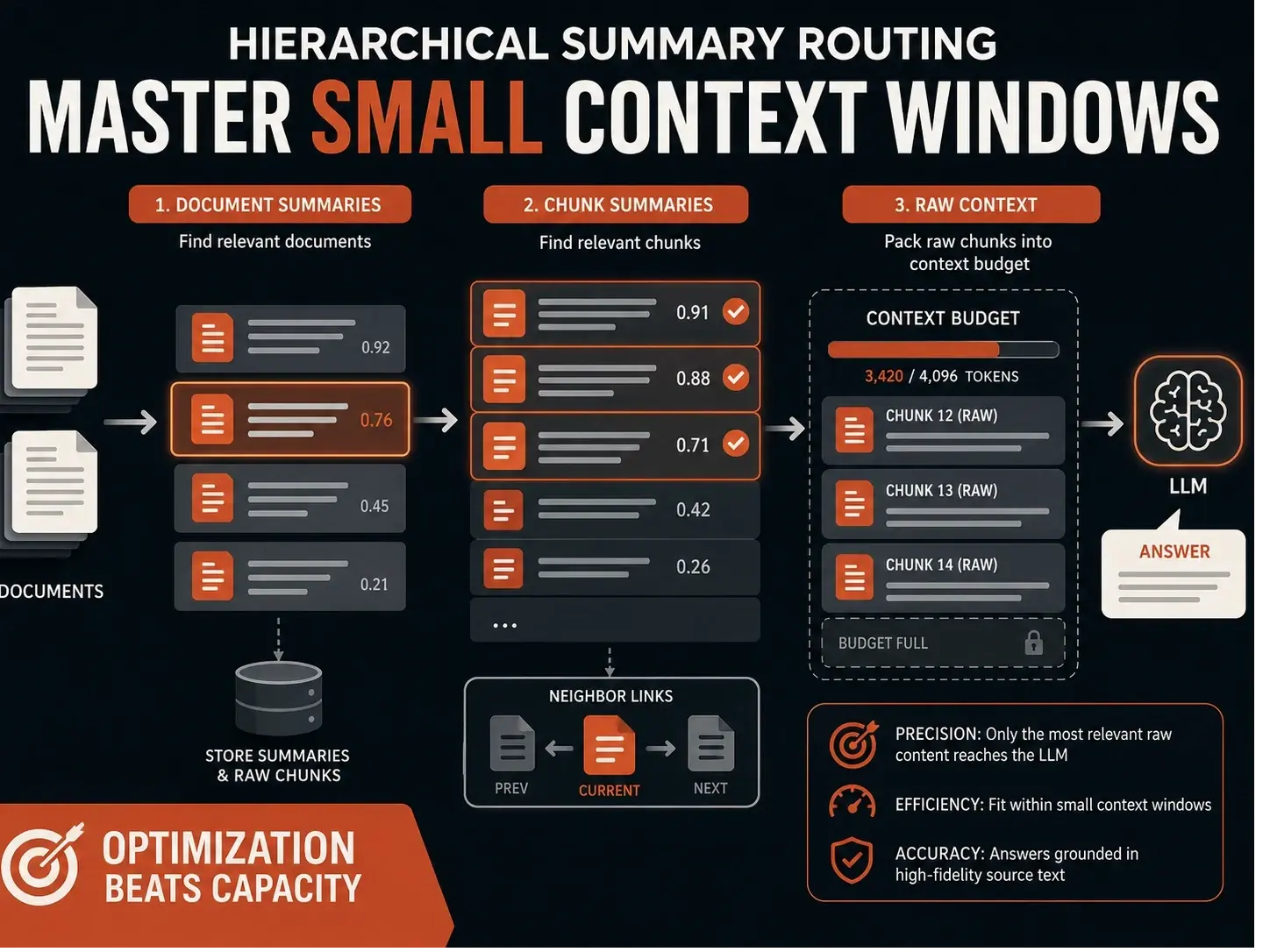
Hierarchical summary routing is a sophisticated, three-layer strategy designed to overcome the limitations of small context windows in RAG systems. This pattern leverages summaries for efficient information discovery while reserving the precious, limited context window for raw, high-fidelity source text, ensuring that the most pertinent details reach the LLM.
This approach involves three distinct levels of processing:
1. Document Summaries: A concise overview of an entire document, primarily used to quickly identify and select documents that are most likely to contain information relevant to a user's query.
2. Chunk Summaries: Shorter summaries generated for individual chunks within a document. These are used to pinpoint specific sections or paragraphs that are highly relevant once a document has been selected.
3. Raw Context: The original, unaltered text of the selected chunks. This is the only content that is ultimately fed into the LLM for generating the final answer, preserving the accuracy and detail of the source material.
The workflow for this pattern is bifurcated into indexing and querying phases:
- Indexing: During this phase, documents are systematically broken down into smaller, manageable chunks. Each chunk is then summarized, and these chunk summaries are further aggregated to create a document summary. These summaries, along with the raw chunks, are stored in an organized index.
- Querying: When a query is received, the system first searches through the document summaries to identify the most promising documents. Subsequently, it searches the chunk summaries within those selected documents to find the most relevant chunks. Finally, the system converts these chunk summary hits back into their raw text form and carefully packs them into the LLM's context window, adhering to the predefined token budget. This ensures that the LLM generates its response directly from the original, unadulterated source material.
The critical insight here is that summaries are inherently lossy; they compress information and may omit crucial details. Therefore, they are used exclusively for routing and selection, never for generating the final answer. The raw chunks, despite being larger, are essential for maintaining the integrity and grounding of the LLM's output.
How do I implement a context budget for local LLMs?
Implementing a context budget for local LLMs is paramount to ensuring that RAG systems operate efficiently and effectively within the constraints of limited computational resources. A context budget is a strict limit on the number of characters or tokens that can be included in the LLM's prompt. This forces the system to intelligently prioritize and select only the most relevant information, preventing prompt overflow and ensuring that the LLM receives a focused and manageable input.
Defining the context budget typically involves considering the available VRAM on the consumer hardware and the specific architecture of the local LLM being used. This budget dictates how much raw text can be packed into the final prompt. A crucial aspect of this implementation is the inclusion of neighbor links (pointers to previous and next chunks) within the chunk records. These links are vital because chunk boundaries are often artificial; an answer might begin in a preceding chunk or extend into a subsequent one. By including neighbor links, the system can dynamically retrieve adjacent chunks, maintaining the logical flow and completeness of the information presented to the LLM.
Effective debugging is also a key component of managing context budgets. By implementing a trace mechanism that logs which chunks were included in the final prompt and which were skipped due to budget limitations, developers can gain invaluable insights. This helps answer a critical debugging question: "Did retrieval miss the evidence, or did prompt assembly drop it?" This transparency allows for fine-tuning the chunking, summarization, and budgeting strategies to optimize performance.
How does this compare to traditional RAG techniques?
The hierarchical summary routing pattern offers significant advantages over traditional RAG techniques, particularly in scenarios with small context windows. Traditional RAG often employs a simpler approach: it retrieves the top-K most relevant chunks based on similarity and then "stuffs" them into the LLM's prompt. While this can be effective for some applications, it frequently falls short when the number of relevant chunks exceeds the context window or when individual chunks are too large.
This brute-force method can lead to several issues:
- Context Destruction: As highlighted by Anthropic, traditional RAG systems can inadvertently destroy context by splitting documents into disjointed chunks that lack sufficient surrounding information.
- Inefficient Resource Usage: Overstuffing the context window with potentially redundant or less critical information wastes valuable tokens and computational resources.
- Suboptimal Performance: When the LLM receives a prompt that is too long or contains irrelevant information, its ability to generate accurate and coherent responses can be compromised.
In contrast, hierarchical summary routing acts as a precision filter. It intelligently navigates through the information hierarchy, using summaries to quickly narrow down the search space and then carefully selecting only the most relevant raw chunks. This balanced approach ensures that the LLM receives a highly focused and optimized context.
Research on Context Window Utilization further supports this approach, indicating that "smaller context windows and suitable chunk sizes (e.g., 512 or 1024 tokens) often result in higher similarity scores than simply increasing the context window usage". This suggests that intelligent context management, rather than merely expanding the context window, is the key to superior RAG performance.
When should you use summary routing instead of standard RAG?
Hierarchical summary routing is particularly beneficial in specific use cases where the limitations of standard RAG become apparent. It is not a one-size-fits-all solution but rather a powerful optimization for scenarios demanding high precision and efficient resource utilization.
This pattern is highly recommended for:
- Local Development and Consumer Hardware: When working with local LLMs on machines with limited VRAM (e.g., 12GB GPUs), where context window constraints are a significant bottleneck.
- High-Precision Technical Documentation: In applications requiring extremely accurate answers from extensive and complex technical documents, where every piece of information must be precisely delivered to the LLM.
- Cost-Sensitive Deployments: For deployments where token usage directly impacts operational costs, optimizing the context window can lead to substantial savings.
Ultimately, the choice between hierarchical summary routing and standard RAG depends on the specific requirements and constraints of your application. However, the overarching principle remains: optimization beats capacity every time. While larger context windows offer more leeway, a well-managed, budgeted context, even a smaller one, will consistently yield more reliable and accurate results. As the APXML Course on RAG emphasizes, "Managing context length is a practical engineering challenge... It requires balancing the desire to provide the LLM with comprehensive context against the hard limits of the model's architecture". By mastering context window limits through intelligent strategies like hierarchical summary routing, developers can unlock the full potential of RAG systems.

FAQ
Frequently Asked Questions
[ Related ]
More in Tips & Tutorials

How to Run an AI Chatbot Locally on Your Own PC
A step-by-step guide to running a private, offline AI chatbot on your own PC using free tools like Ollama and LM Studio, plus the hardware, models, and tradeoffs to know before you start.

How to Remove Claude Fable 5.1's Text Watermark
Claude Fable 5.1 is the first Claude model to ship with an invisible text watermark live from launch. Here's what it actually marks, who can check for it, and what genuinely removes it.

Google Engineers' Best AI Prompts for Developers
Google Cloud asked ten of its own engineers what AI prompt they refuse to work without. The answers reveal a single pattern: turn AI into a skeptical second opinion, not an agreeable assistant.

This Stealth Model Makes Claude Code Free. Here's How.
An anonymous model called Ox Alpha landed on OpenRouter at $0 per token, and Claude Code is one of its biggest consumers. Here is the exact setup, plus the speed, privacy and expiry costs nobody puts in the tutorial.

How to Write a CLAUDE.md File Claude Code Actually Follows
A good CLAUDE.md is short and specific, not long and thorough. Here's what actually belongs in one, what to cut, and why the line count matters more than most people realize.
How to Build Verification Loops in Claude Code With Skills
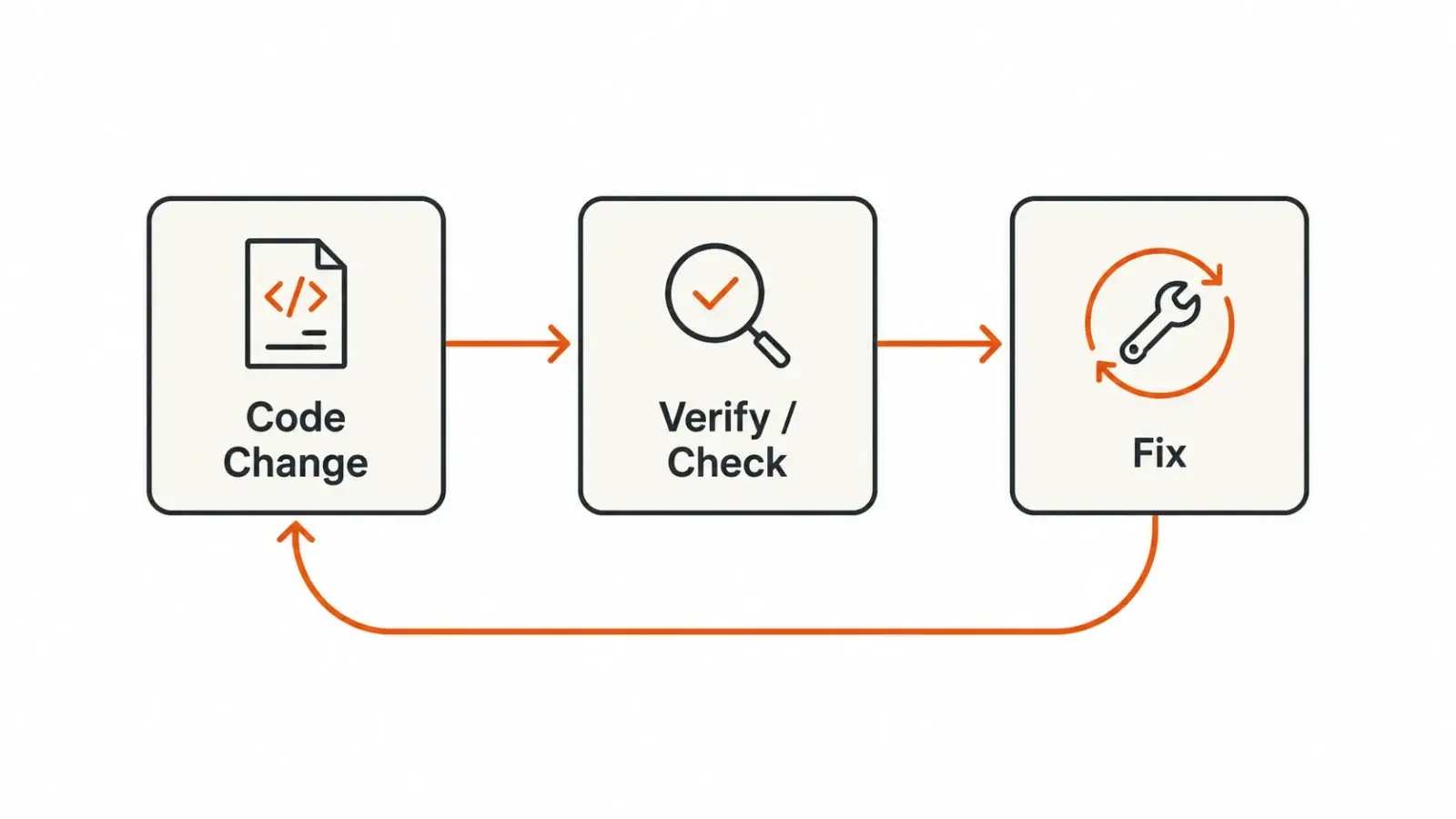
Learn how to turn the manual checks you already do into skills, so Claude Code tests, fixes, and verifies its own work automatically.