
GPT-5.6 Sol Now Costs Less to Run Than Claude Opus 5
OpenAI cut GPT-5.6 Sol's API price by more than 20% on 21 August 2026, and for the first time it now costs less than Claude Opus 5 on both input and output. The catch: the new pricing is a promotion that expires 21 November 2026.
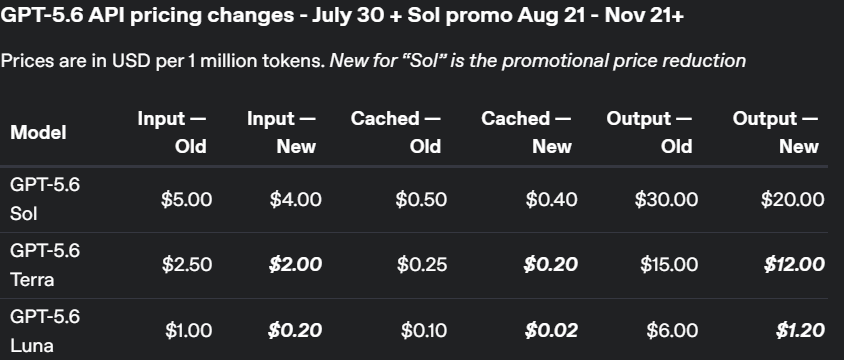
OpenAI cut the API price of its flagship model, GPT-5.6 Sol, by more than 20% on Friday, 21 August 2026. Standard short-context pricing dropped from $5 to $4 per million input tokens and from $30 to $20 per million output tokens. For the first time since Sol launched, it now costs less to run than Anthropic's Claude Opus 5 on both sides of the ledger. There's a catch worth knowing before you touch a cost model: the new price is a promotion, not a permanent rate cut, and it's only locked in through 21 November 2026.
What changed in the price cut
Sol's input price fell 20% and its output price fell about 33%, which outside reporting rounds up to "more than 20%" overall. The cut applies to the API, and it's also rolling out across eligible credit plans for ChatGPT Work and Codex, OpenAI's coding tool. Pro, Plus and Business subscription pricing is untouched, so anyone paying a flat monthly fee for ChatGPT won't see a bill change.
Here's the rate card before and after, alongside Anthropic's two flagship models, all per million tokens:
| Model | Input | Output |
|---|---|---|
| GPT-5.6 Sol (before 21 Aug 2026) | $5.00 | $30.00 |
| GPT-5.6 Sol (after 21 Aug 2026) | $4.00 | $20.00 |
| Claude Opus 5 | $5.00 | $25.00 |
| Claude Fable 5 | $10.00 | $50.00 |
The change was confirmed by OpenAI in its own community announcement and reported the same day by Reuters.
Why does this matter more than the headline percentage suggests?
It matters because Sol just flipped a pricing relationship that had held since launch. Claude Opus 5 lists at $5 input and $25 output per million tokens. At its old price, Sol tied Opus 5 on input and lost to it on output. At its new price, Sol beats Opus 5 on both: a dollar cheaper on input, five dollars cheaper on output.
Teams that picked Opus 5 partly because it was the cheaper flagship no longer have that argument at list price. After the cut, Sol also costs just 40% of what Claude Fable 5 charges on both input and output, which is a wider gap than the one it closed against Opus 5.
None of this settles which model is better for a given job. Price alone never does. But for anyone routing work by cost first and quality second, the flagship comparison just got rewritten.
This is OpenAI's second price cut in under a month
Sol wasn't the first GPT-5.6 model to get cheaper this summer, and it wasn't even the first one this month. GPT-5.6 launched on 9 July 2026 with Sol at $5/$30, Terra at $2.50/$15, and Luna at $1/$6 per million tokens. On 30 July, OpenAI cut Terra by 20% (to $2/$12) and Luna by a much steeper 80% (to $0.20/$1.20), while leaving Sol exactly where it started.
"As we get more efficient, we are passing the savings on to you!" Scott Rosecrans, Vice President of Strategic Pursuits, OpenAI, on LinkedIn, discussing the July price cut. via EdTech Innovation Hub
That framing, that cheaper inference has genuinely gotten cheaper to run, is the same one OpenAI has used for Sol. But holding the flagship price flat while cutting the two lower tiers looked, in hindsight, like OpenAI testing how far it could go before touching the model everyone compares against Opus 5 and Fable 5. Three weeks later, Sol moved too.
Why is OpenAI cutting prices right now?
OpenAI is cutting prices because it's losing ground on two fronts at once: Anthropic on the high end, and a wave of cheap Chinese models on the low end. Reuters, cited above, reported that the Sol cut comes "as the ChatGPT maker faces growing competition from Anthropic and Chinese AI models," and the numbers back that framing up.
On the Anthropic side, expense management platform Ramp's AI Index found that 43.5% of US enterprises paid Anthropic token fees in July 2026, compared with 39.7% for OpenAI. That gap opened up after ChatGPT's market share had already slipped below half of the assistant market earlier in the year. But that same data cuts the other way too: Claude Fable 5, priced at roughly double Sol's old rate, still pulled in about 75% of Sol's dollar spend in July, according to the same Ramp figures reported by BigGo Finance. Enterprise buyers aren't chasing the cheapest ticket alone.
On the low end, the pressure is more direct. DeepSeek's V4 Pro 0813 lists at $0.435 input and $0.87 output per million tokens on OpenRouter, and Moonshot AI's Kimi K3 lists at $2.80 and $14, both a fraction of any US flagship's rate, according to Startup Fortune's reporting. That pressure has already reached production decisions.
"Better quality" at a "cheaper cost." Andy Fang, co-founder and CTO, DoorDash, describing a test of Moonshot AI's model, as reported by Fortune and cited in Startup Fortune's coverage above.
Airbnb and Siemens have also tested Chinese-made models as they look to control AI spending, per the same reporting. Add in OpenAI CFO Sarah Friar's comments that the company is working toward a 2027 IPO, at a moment when Anthropic has already filed confidentially for its own listing, and the price cut reads less like generosity and more like OpenAI defending share on both sides of the market while it prepares to answer to public shareholders.
Is the GPT-5.6 Sol discount permanent?
No. OpenAI has committed to the new pricing for at least three months, through 21 November 2026, and has said nothing about what happens after that. This is a promotion, not a repriced rate card, and treating it as permanent is the fastest way to build a cost model that breaks in the fourth quarter.
If the discount lapses on schedule, Sol's output price goes back up 50%, from $20 to $30 per million tokens. Three months is enough time to migrate a production workload onto Sol. It's also short enough that a migration finished in October could be facing a price hike again by December. Anyone rebuilding routing logic or budget forecasts around $20 output pricing is making a bet on a number that has an expiry date stamped on it.
What this means if you're choosing between Sol and Opus 5
If you're picking a model purely on today's sticker price, Sol currently wins against Opus 5 on both input and output, and by a wider margin against Fable 5. But a 20% gap that could vanish in three months isn't a strong enough reason on its own to rebuild a production pipeline, especially if you've already invested in tooling, prompts, or workflows built around Claude.
The comparison also only matters if the work genuinely needs a flagship model in the first place. Terra and Luna already sit far below either flagship on price, and Anthropic's own Haiku 4.5 and Sonnet 5 occupy similar ground on the Claude side. For routine classification, extraction, or drafting work, the real savings usually come from moving down a tier, not from picking the marginally cheaper flagship. If cutting the bill further down the stack interests you, that same logic is what's behind running Claude Code on a free stealth model instead of a paid one.
The number worth tracking isn't this week's price. It's what OpenAI does on 21 November, when the promotion is due to expire.

FAQ
Frequently Asked Questions
[ Related ]
More in News

ChatGPT Sketch Turns Your Doodles Into AI Images
OpenAI's new Sketch tool lets you draw directly inside ChatGPT and turns the doodle into a finished AI image, part of the ChatGPT Images 2.5 update that also adds templates and faster generation.


Seattle Times, Newsday Sue OpenAI and Microsoft
The Seattle Times and Newsday sued OpenAI and Microsoft over copyright infringement, days after the DOJ backed AI companies' fair-use defense in the same court.

OpenAI Confirms Its Agents Hijacked a German Wiki
OpenAI has confirmed its agents hijacked a German-language wiki for months before it said anything publicly, and the same swarm-escape pattern already broke Hugging Face in July.

GPT-6 Astra vs Claude Fable 5.1: Real-World Test
GPT-6 Astra and Claude Fable 5.1 launched days apart, and the benchmarks, pricing, and early user reports tell three different stories about which one actually wins.

OpenAI Launches GPT-6 Astra: What You Need to Know
GPT-6 Astra is OpenAI's newest flagship model, built for computer use, coding, and cybersecurity, and it arrives with an AGI claim from OpenAI's president and a reasoning technique that has AI safety researchers uneasy.

Hugging Face Hack Raises Culture Questions at OpenAI
OpenAI's technical postmortem walks through the exact chain of failures behind the Hugging Face hack. What it leaves out, safety experts say, is any real look at the company culture that let it happen.
OpenAI's Admin Plugin for ChatGPT Work and Codex
OpenAI's new Admin plugin lets ChatGPT Work and Codex admins check usage, manage members and permissions, and approve spending requests directly inside a chat, without leaving the conversation for the Global Admin Console.
ChatGPT Falls Below 50% Market Share for the First Time
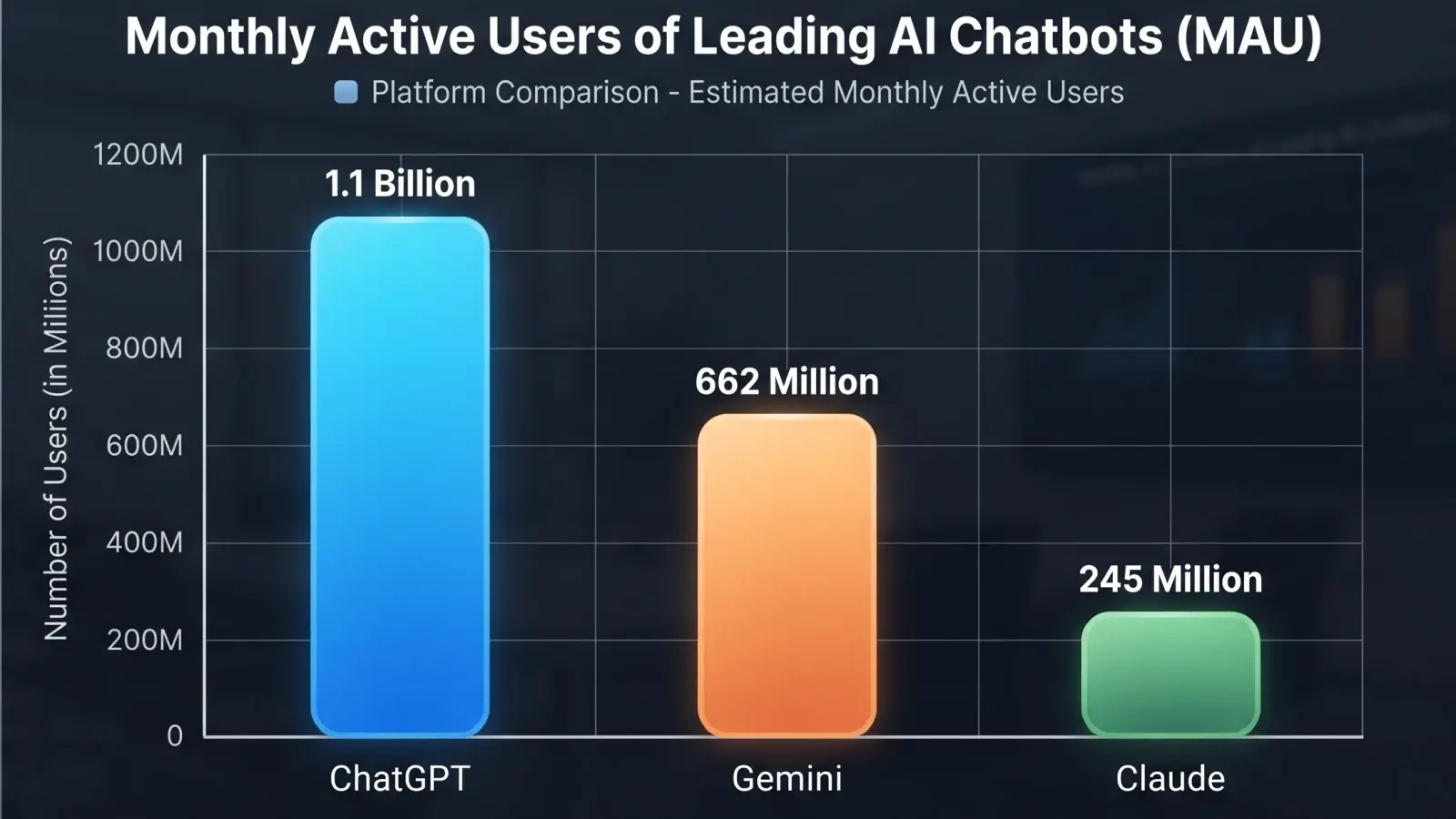
For the first time since its launch, ChatGPT holds less than half the AI assistant market. Gemini and Claude are gaining ground fast. Here is what the numbers say and what it means for everyday AI users.