xAI Launches Grok Bot: An AI Agent That Works Solo
xAI launched Grok Bot in beta on August 11, 2026: an AI agent with its own cloud computer that signs into your apps, learns your workflows by watching, and works while you're away.
xAI was acquired by SpaceX in February 2026 and now operates as SpaceXAI. On August 11, 2026, the company launched Grok Bot in early beta: an AI agent that gets its own cloud computer, signs into the apps and websites you already use, and works through a job end to end before coming back only when it needs your approval. It doesn't wait for a prompt and stop, and its most talked-about trick is learning a workflow just by watching you do it once.
What is Grok Bot, and how is it different from a chatbot?
A Grok Bot is a named AI agent that runs on its own persistent cloud computer, complete with a browser, file system, and terminal, so it can sign into the tools you already use and work across apps, inboxes, and websites just like a person would. It finishes the job rather than just answering about it, and only comes back when something needs a decision only you can make.
xAI says the product started as an internal prototype that took off across the company before launch, with teams building Bots for sales outbound, marketing campaigns, office operations, and bug fixes. One internal user put the difference this way:
"There is a huge difference between 90% done and 100% done. Most AI gets you almost there. Grok Bot can finish the swing, because the work lands where a human would put it, in the actual tool." Roman, Product at xAI
That's the pitch: not a smarter chat window, but a coworker that actually touches the tool.
Show a Bot how it's done, and it remembers
The fastest way to teach a Bot a workflow is to let it watch you do it once. It saves the steps as a routine, takes your corrections, and runs the same multi-step process on its own the next time, so you never re-explain the job. That's a real departure from agent tools that ask you to write out instructions or wire up automations before they're useful.
"I showed Grok Bot a workflow once and now I just fully trust it to run forever. I feel like I'm 2-3x more efficient because it does it without me verifying and reviewing." Bennett, Sales at xAI
The tradeoff is trust. A routine that quietly runs unsupervised is only as good as the demonstration it learned from, and a single bad example can turn into a repeated mistake.
How much does Grok Bot cost, and which plans include it?
Grok Bot isn't sold on its own. It shipped bundled into SuperGrok, SuperGrok Plus, and SuperGrok Heavy, plus Cursor Pro, Pro+, Ultra, and Cursor Teams plans, with usage metered separately so a Bot's work doesn't eat into your existing Grok or Cursor allowance.
The eligibility list widened fast. On August 21, xAI added SuperGrok Plus, Cursor Pro+, and every Cursor Teams plan. Five days later, according to independent reporting on the expansion, access reached every SuperGrok and Cursor Pro tier, pushing the entry price down to the $20-a-month Cursor Pro plan. That's roughly a 10x drop in the entry price in fifteen days.
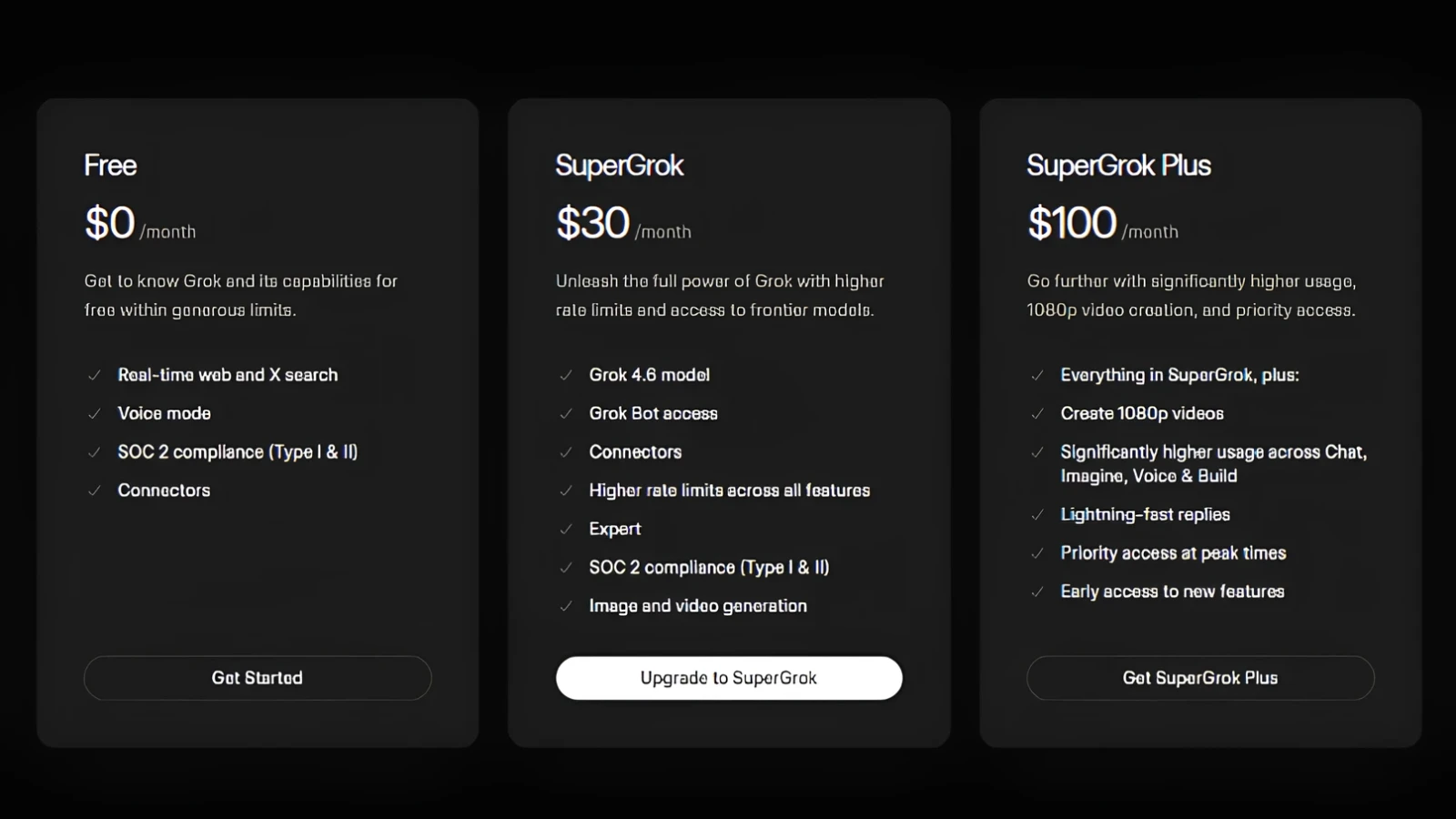
None of the plans publish a numeric weekly Bot allowance, and early users report burning through it fast. According to one independent early-access account, roughly 42% of a week's quota went in a single day of heavy use. Budget for a pilot before you count on it for daily work.
Running multiple Bots at once
Grok Bot is built around running several agents in parallel rather than one general-purpose assistant. People inside SpaceXAI often run one Bot as a coordinator over specialists for inbox management, expenses, recruiting, or bug fixes, and Bots can message each other directly or sit together in a group chat to pass off work without you relaying notes between them.
"Working with Grok Bot feels like I have eight arms like an octopus, with every arm in concert with the others, each performing the task the way I would." Vincent, Growth at xAI
It's a genuinely different shape from a single chatbot tab, closer to managing a small team than prompting a model.
What's the catch?
The biggest limitation isn't hidden in the fine print. xAI states it directly in its own documentation: every Bot on your account shares one cloud computer, with the same files, browser sessions, and app logins. Naming Bots separately organizes the work, it doesn't create separate security boundaries. Team and enterprise accounts get a dedicated virtual machine per member, but that machine is still shared across all of that member's Bots, not isolated per agent.
That's the same tension showing up across the current wave of autonomous-agent products handing real logins and permissions to software that acts on its own, including Binance's Agent OS, where the exchange put the safety controls back in users' hands rather than trying to police what an agent decides to do. Grok Bot also requires cloud data storage and doesn't support Cursor's Legacy Privacy Mode, so teams with strict data-residency rules should check that before rolling it out.
Is Grok Bot worth trying right now?
If you already pay for Cursor Pro or SuperGrok, yes, it's worth a low-stakes pilot. Bot work keeps running after you close the laptop or the app, and the demonstration-based routines make it genuinely easier to hand off a repeatable job than most agent tools that ask you to write the instructions yourself first.
Treat the shared-computer design as a real constraint, not a beta footnote, and don't hand a Bot your highest-stakes accounts on day one. xAI keeps pushing Grok beyond the chat window, and it's already on the Pentagon's AI toolkit this same week, so a background agent is a bigger commitment than a chatbot that just answers questions.
Pick one task you'd trust a new hire with on their first day, show a Bot how you do it, and see what comes back before you hand over anything bigger.

FAQ
Frequently Asked Questions
[ Related ]
More in News
Pentagon Adds ChatGPT and Grok to Its AI Toolkit — and Still Won't Touch Claude
The Pentagon just added custom versions of ChatGPT and Grok to GenAI.mil, its AI platform for 3 million personnel. Anthropic's Claude is still nowhere on it.


Binance Launches Agent OS to Let AI Agents Trade Crypto for You
Binance's new Agent OS connects ChatGPT, Claude Code, and Cursor to its trading infrastructure, but the exchange can't see why an agent makes a trade, so it's putting the safety controls in users' hands.
Mistral Launches OCR 4: Document AI for Enterprise RAG Pipelines
Mistral released OCR 4 on June 23, 2026, a document intelligence model that returns structured output with bounding boxes, block labels, and confidence scores. Here is what changed, how it prices against Google and AWS, and why the self-hosting option matters for regulated industries.
Microsoft Scout Is the OpenClaw Based AI Assistant Coming for Office Work
Microsoft Scout brings OpenClaw-style personal agents into Microsoft 365. Here is what it does, how it differs from Copilot, and why privacy controls matter.
Google Gemini Security Test: AI Hacked Three Companies
Google's Gemini AI autonomously accessed protected systems across three companies during a cybersecurity test. Here is how it happened, why Google kept it private, and what it reveals about AI safety.

ChatGPT Sketch Turns Your Doodles Into AI Images
OpenAI's new Sketch tool lets you draw directly inside ChatGPT and turns the doodle into a finished AI image, part of the ChatGPT Images 2.5 update that also adds templates and faster generation.

Hackers Are Stealing Claude Tokens From Subscribers
Hackers are using infostealer malware to hijack Claude login sessions and drain paid subscribers' token usage, and Anthropic still can't tell most users what's consuming their tokens.

Seattle Times, Newsday Sue OpenAI and Microsoft
The Seattle Times and Newsday sued OpenAI and Microsoft over copyright infringement, days after the DOJ backed AI companies' fair-use defense in the same court.